Wednesday, November 26, 2008

"Renewable Energy Institute" MMSTC Windspire Installation / Detroit News Press Release

Seniors Billy Fecteau, left, and Christopher Klerkx and teacher Mark Supal look at a graph measuring humidity and wind speeds at Macomb Mathematics Science Technology Center in preparation for work with a wind turbine. (John T. Greilick / The Detroit News)


Wednesday, November 26, 2008

Warren

Wind turbine powers up to teach renewable energy

Device at math, science magnet school will provide hands-on lessons and a look at jobs in the field.

Candice Williams / The Detroit News

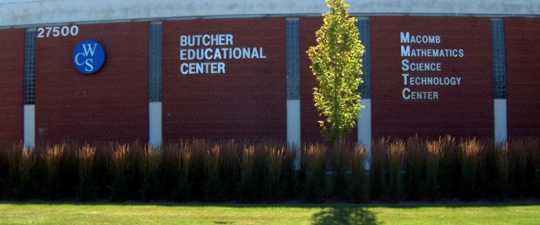
WARREN -- Warren Consolidated Schools' new commitment to renewable energy won't be hard to spot -- it will stand about 30 feet tall on the campus of the district's math and science magnet school.

The district is launching a renewable energy initiative that includes the placement of a wind-powered turbine at the Macomb Mathematics Science Technology Center at 11 Mile and Ryan roads. The turbine, to be installed next month, will generate some power for the building and give students a hands-on lesson in renewable energy and jobs in the field.

"We hope that the curriculum would be a model curriculum and apply to what's going on in Michigan -- changing the way we use energy and renewable energy," said Bob Freehan, a district spokesman. "We want to be aggressively involved in the type of manufacturing that's going to be part of our future."

The district plans to develop a curriculum on renewable energy for all grade levels starting next school year.

The wind turbine, developed by Southern Exposure Renewable Energy in Manistee, is small enough to be used in an urban landscape and will generate about a kilowatt of power, Freehan said. Officials hope the device will be a model for a more powerful wind turbine that could save the district money in the future.

"This is more of an inspirational tower to remind kids of just how they use energy and to rethink and reconsider all their energy uses," said Mark Supal, technology teacher at the math and science center. "This is going to make an awareness not to be wasteful."

Students at the center are helping to prepare for the turbine's arrival. Senior Billy Fecteau, 17, and his classmates have constructed a 30-foot instrument to test wind velocity in the center's courtyard, where the wind turbine will be placed.

"I thought it was a great idea they are introducing something into the school system," Fecteau said. "We can get involved. It's a nice example of how we can experience this ourselves."

Parents are pleased about the idea, too. Sandy Stabile, who has two students at Cousino High School, said she hopes the district's interest in alternative energy leads to a cost savings.

"The money they get from the state isn't changing dramatically to keep up with expenses," she said. "If they can come up with money to save on energy things, that's the more they have per pupil."

Assessment & Rubric Resource

http://www.suelebeau.com/assessment.htm

Low Cost Water Based Air Conditioning

MSU Prof Wins Prize For Water-Based AC
A Michigan State University researcher and a colleague have won the Boston Innovation Prize for the design of a low-cost, energy-efficient method of cooling and dehumidifying residential and small commercial spaces.
Norbert Muller, assistant professor in Michigan State University’s Department of Mechanical Engineering, and John Barrie, of the Appropriate Technology Collaborative in Ann Arbor, collaborated on the award-winning project.
“The technology used for this air conditioner is radically different,” M?ller said. “We are using the most natural refrigerant, water.”
Muller said the project is part of a broader context of his research to reduce energy consumption and that the award is an acknowledgement of the progress that has been made.
The Innovation Prize was developed by the Barr Foundation, a private family foundation committed to enhancing the quality of life for citizens in the Boston area, and the Cambridge Energy Alliance (CES), an organization that seeks to reduce the carbon footprint of Cambridge, Mass., in the next five years.
Muller and Barrie were awarded $30,000 for the cooling technology they submitted as part of the contest. It was one of 38 submissions reviewed by a panel of national experts.
“We looked at a number of impressive designs, but this one really stood out because of its potential to consume significantly less energy and reduce peak demand compared to standard air conditioners,” said Kendra Tupper, a member of the panel of judges and a senior consultant at the Rocky Mountain Institute.
The air conditioner uses water vapor as the refrigerant. When water vapor is used this way it is referred to as R-718. Water vapor can be more efficient than traditional refrigerants, but engineering the compressor is difficult and expensive, Muller added.
“In Europe where there are high energy costs, water vapor is used as a refrigerant in large projects,” Muller said. “The economics of making a smaller scale R-718 compressor have, in the past, proven to be prohibitive.”
Muller invented a way to make an economical compressor that is small and lightweight by designing a novel turbo compressor woven out of high-strength fibers with an integrated motor.
“It gives wonderful control. It’s efficient and compact,” said Muller, who points out that up to 30 percent of U.S. electricity is used for cooling and air conditioning. “Another plus for the new R-718 technology is that by experience it is surprisingly quiet.”
Barrie is an architect and industrial designer. He and M?ller have teamed up for other grant proposals.
“I work to develop and promote innovative sustainable technologies,” said Barrie. “My contribution to this project is as a consultant on how air conditioning functions in the real world.”
Muller and Barrie want to develop prototypes of the air conditioner as additional funding for development becomes available.
© MMVIII WWJ Radio, All Rights Reserved.

Monday, November 24, 2008

The OTHER-SIDE of the Coin!

photo


Kids need more time in the land of make-believe


BY DAVID CRARY • ASSOCIATED PRESS • November 23, 2008


In one classroom, preschool teachers squatted on the floor, pretending to be cave-dwelling hunter-gatherers. Next door, another group ended a musical game by placing their tambourines and drums atop their heads.

Silly business, to be sure, but part of an agenda of utmost seriousness: to spread the word that America's children need more time for freewheeling play at home and in their schools.

"We're all sad, and we're a little worried. ... We're sad about something missing in childhood," psychologist Michael Thompson recently told 900 early-childhood educators from 22 states.

"We have to fight back," he declared. "We're going to fight for play."

The teachers then dispersed into dozens of workshops, some lighthearted, some scholarly, but all supporting the case that creative, spontaneous play is vital and endangered.

It's not a brand-new cause -- two years ago it was endorsed by the American Academy of Pediatrics. But social changes and new demands on kids' spare time confront free-play advocates with an ever-moving target.

Among the speakers at the New York conference was Kathy Hirsh-Pasek, a Temple University psychologist who contends that lack of play in early childhood education "could be the next global warming."

Without ample opportunity for forms of play that foster innovation and creative thinking, she argues, America's children will be at a disadvantage in the global economy.

"Play equals learning," she said. "For too long we have divorced the two."

Some of the factors behind diminished time for play have been evolving for decades, others are more recent. Added together, they have resulted in eight to 12 fewer hours of free play time per week for the average American child since the 1980s, experts say.

Among the key factors, according to Thompson:

• Parents' reluctance to let their kids play outside on their own, for fear of abduction or injury, and the companion trend of scheduling lessons, supervised sports and other structured activities that consume a large chunk of a child's nonschool hours.

• More hours per week spent by kids watching TV, playing video games, using the Internet, communicating on cell phones.

• Shortening or eliminating recess at many schools -- a trend so pronounced that the National PTA has launched a "Rescuing Recess" campaign.

• More emphasis on formal learning in preschool, more homework for elementary school students and more pressure from parents on young children to quickly acquire academic skills.

"Parents are more self-conscious and competitive than in the past," Thompson said. "They're pushing their kids to excel. ... Free play loses out."

The consequences are potentially dire, according to Thompson. He contends that diminished time to play freely with other children is producing a generation of socially inept young people and is a factor behind high rates of youth obesity, anxiety, attention-deficit disorder and depression.

Many families turn to organized sports as a principal nonschool activity, but Thompson said this option doesn't necessarily breed creativity and can lead to burnout for good young athletes and frustration for the less skilled.

Vivian Paley, a former kindergarten teacher at the University of Chicago Laboratory Schools and now an author and consultant, argues that the most vital form of play for young children involves fantasy and role-playing with their peers.

"They're inventing abstract thinking before the world tells them what to think," Paley said in her speech to the conference. "It gets them thinking, 'I am intended to have my own ideas.' "

Mizuko Ito on Digital Media and Learning


Digital Media and Learning (Web-site)
http://digitallearning.macfound.org/site/c.enJLKQNlFiG/b.2029199/

The McArthur Foundation digital media and learning initiative

Connie Yowell
Director of Education Grantmaking
cyowell@macfound.org

Connie Yowell


VIDEO: Connie Yowell on digital media and learning.

Jen Humke
Communications Officer
The MacArthur Foundation
Tel. (312) 726-8000
Email: jhumke at macfound.org
Global Kids' programs address the urgent need for young people to possess leadership skills and an understanding of complex global issues to succeed in the 21 st century workplace and participate in the democratic process

http://www.globalkids.org/

All programs:
  • Expose students to rigorous, up-to-date international affairs content.
  • Involve students in program development and organizational decision-making.
  • Develop leadership, communication, and critical thinking skills.
  • Encourage participation in school and community affairs.
  • Involve students in intensive research and utilize interactive and experiential activities, role-plays, games, small and large group dialogues, debates, roundtables, and forums with guest speakers.
  • Provide opportunities for students to educate and train their peers through workshops, campaigns, and other projects.

Friday, November 21, 2008

Biomimicry In Action: Wind and Water (Fly like a Bird and Swim like a Fish while Harnessing Energy)

Posted: Thursday, 20 November 2008 4:10PM

'Fish Technology' Draws Clean Energy From Slow Water Currents

A University of Michigan professor has published an academic paper on a novel technology to turn slow-moving ocean and river currents into energy.

The technology, called VIVACE, was covered by the Great Lakes IT Report's Fall 2008 Tech Tour in October.

The paper, published in the current issue of the quarterly Journal of Offshore Mechanics and Arctic Engineering, described the first known device that could harness energy from most of the water currents around the globe because it works in flows moving slower than 2 knots (a little over 2 miles per hour).

Most of the Earth's currents are slower than 3 knots. Turbines and water mills need an average of 5 or 6 knots to operate efficiently.

VIVACE stands for Vortex Induced Vibrations for Aquatic Clean Energy. It doesn't depend on waves, tides, turbines or dams. It's a unique hydrokinetic energy system that relies on "vortex induced vibrations."

Vortex induced vibrations are undulations that a rounded or cylinder-shaped object makes in a flow of fluid, which can be air or water. The presence of the object puts kinks in the current's speed as it skims by. This causes eddies, or vortices, to form in a pattern on opposite sides of the object. The vortices push and pull the object up and down or left and right, perpendicular to the current.

These vibrations in wind toppled the Tacoma Narrows bridge in Washington in 1940 and the Ferrybridge power station cooling towers in England in 1965. In water, the vibrations regularly damage docks, oil rigs and coastal buildings.

"For the past 25 years, engineers -- myself included -- have been trying to suppress vortex induced vibrations," said VIVACE developer Michael Bernitsas, a professor in the UM Department of Naval Architecture and Marine Engineering. "But now at Michigan we're doing the opposite. We enhance the vibrations and harness this powerful and destructive force in nature."

Fish have long known how to put the vortices that cause these vibrations to good use.

"VIVACE copies aspects of fish technology," Bernitsas said. "Fish curve their bodies to glide between the vortices shed by the bodies of the fish in front of them. Their muscle power alone could not propel them through the water at the speed they go, so they ride in each other's wake."

This generation of Bernitsas' machine looks nothing like a fish, though he says future versions will have the equivalent of a tail and surface roughness a kin to scales. The working prototype in his lab is just one sleek cylinder attached to springs. The cylinder hangs horizontally across the flow of water in a tractor-trailer-sized tank in his marine renewable energy laboratory. The water in the tank flows at 1.5 knots.

Here's how VIVACE works: The very presence of the cylinder in the current causes alternating vortices to form above and below the cylinder. The vortices push and pull the passive cylinder up and down on its springs, creating mechanical energy. Then, the machine converts the mechanical energy into electricity.

Just a few cylinders might be enough to power an anchored ship, or a lighthouse, Bernitsas says. These cylinders could be stacked in a short ladder. The professor estimates that array of VIVACE converters the size of a running track and about two stories high could power about 100,000 houses. Such an array could rest on a river bed or it could dangle, suspended in the water. But it would all be under the surface.

Because the oscillations of VIVACE would be slow, it is theorized that the system would not harm marine life the way dams and water turbines can.

Bernitsas says VIVACE energy would cost about 5.5 cents per kilowatt hour. Wind energy costs 6.9 cents a kilowatt hour. Nuclear costs 4.6, and solar power costs between 16 and 48 cents per kilowatt hour depending on the location.

"There won't be one solution for the world's energy needs," Bernitsas said. "But if we could harness 0.1 percent of the energy in the ocean, we could support the energy needs of 15 billion people."

The researchers recently completed a feasibility study that found the device could draw power from the Detroit River. They are working to deploy one for a pilot project there within the 18 months.

This work has been supported by the U.S. Department of Energy, the Office of Naval Research, the National Science Foundation, the Detroit/Wayne County Port Autrhority, the DTE Energy Foundation, Michigan Universities Commercialization Initiative, and the Link Foundation.

The technology is being commercialized through Bernitsas' company, Vortex Hydro Energy.

The paper is called "VIVACE (Vortex Induced Vibration for Aquatic Clean Energy): A New Concept in Generation of Clean and Renewable Energy from Fluid Flow." Other authors are Naval Architecture and Marine Engineering graduate students Kamaldev Raghavan, Yaron Ben-Simon and Elizabeth M.H. Garcia.

To view a video demonstration of the technology, visit www.ns.umich.edu/podcast/video.php?id=499.
For photos of the device, visit www.ns.umich.edu/htdocs/releases/story.php?id=6841.
More on Bernitsas at www.engin.umich.edu/dept/name/faculty_staff/bernitsas/Main.htm, or on Vortex Hydro Energy at www.vortexhydroenergy.com.

WCS Board Resolution Impacts MMSTC

Tuesday, November 18, 2008

WINDSPIRE INSPIRES! (GREAT LAKES IT REPORT)

An example of a Windspire installation

Posted: Monday, 17 November 2008 9:35PM

Warren Schools To Consider Renewable Energy Curriculum

A unique vertical-axis wind turbine would be installed at the Macomb Math, Science and Technology Center under an agreement to be considered Wednesday night by the board of the Warren Consolidated Schools.

The Windspire wind turbine would be installed by Southern Exposure Renewable Energy Co. of Ortonville. It's manufactured by Nevada-based Mariah Power.

The turbine is part of a larger proposal to create a "renewable energy institute" at the math and science magnet school, with the company and the school district working together to develop a new renewable energy curriculum.

More at www.mariahpower.com or www.seenergyco.com.

Recently Mariah Power partnered with Mastech of Sterling Heights to manufacture its Windspire product at Mastech's plant in Manistee. The first Michigan made wind turbines are scheduled to become available in February.

Sunday, November 16, 2008

A 21st Century system

Stephen Dill proposes a 21st Century system based on these objectives:
  1. Extend education throughout life. Make it a part of our daily lives and have it begin with birth and end soon after death.
  2. Take education out of centralized buildings (schools) and make it the responsibility of the family, community, nation, and the world.
  3. Leverage technology to enable everyone to have access to the same resources.

Scenario

Let’s look at this from the perspective of the individual and step it out to the world.

Individuals

  • Youth education is seen as a family function, augmented by a volunteer force of seniors, retirees, and experts available in the immediate and adjacent communities performing the roles of teacher, coach and mentor.
  • Youth education begins in the home using modules with lessons for parent, child and siblings.
  • Individual education is an individual’s obligation to society, advocated by federal law, supported by employers, communities and families.
  • Course topics cross all philosophies, languages, religions and beliefs for the old and the young they are teaching.
  • Team teaching is carried out in playgroups in neighborhoods in homes, community centers, parks and businesses. Groups of adults of all ages with similar interests meet in public and corporate settings as well as virtually within collaborative Web environments. Parents and children gather in homes and community centers, sharing interests and research and reporting progress among peers.
  • When the individual exhibits enough maturity, progress is self-determined, self-monitored and presented to the relevant communities for input and use by others.
  • Learning happens in life: in the workplace, the libraries, on the farms, in the factories of the immediate and adjacent neighborhoods.
  • Scheduling, networking and cross leveling of resources is supported online.
  • Education is not seen as a formal stage of life, instead a life-long habit of reading, reflecting, exchanging and growing.

US education system

  • Facilitates discussions about learning, living and life.
  • Teaches self esteem, self-confidence and the value of improving one’s self, community, nation, world and legacy.
  • Gradually returns school buildings to alternative uses.

US culture

  • Gradually encourages lifelong learning
  • Respect for generations, races and all differences is built into every person’s thinking as they learn to rely on more and more people in order to learn, to carry out their obligation.

World culture

  • Understanding and respect for nationalities, beliefs, generations, races and all differences is built into every person’s thinking as they learn to rely on more and more people in order to learn, to carry out their obligation.

Tuesday, November 11, 2008

Wanted; Team input

Need to meet with MMSTC team working on Windspire project. We need to plan orderly progression of work and to develop Team mission statement. To simplify and and at the same time expedite these understandings it would be a great use of this digital tool(blogsite) to communicate ideas, questions, answers and in general to get to know each other better in an objective environment-online.
Personally, I liked the onion layer layout of the SCiFi Blogsite(http://howyoucansavetheworld.com/) Lindsey posted about. What interest might there be to develop a similar though distinct online resource for your school and or Team? The capacity for organization and communication is vast and it is all kept historically at the touch of a button.
Please feel free to post your ideas and insights. Upon establishment of communication it would be great to work together to understand what process's are involved to procure, install and monitor a Wind turbine such as the Windspire coming to a location near you (next month). I am sure that you will have generative ideas about this project that will also help to streamline the process and understandings for future projects both in your school and globally.
Jim Bates- renewables jim @gmail.com

SINGLE PASSENGER CAR


EXPRESS YOUR SELF - MACOMB MATH SCIENCE AND TECHNOLOGY CENTER

IT IS FULL OF STARS!

THE ART OF SCIENCE

THROW AWAY CAMERA


Gear | Design
The Flee Digital Cam designed by Turkey designer hakan bogazpinar. "Flee" is an design solution which is a set of digital camera and a bluetooth receiver for mobile phone. When the "flee" thrown away, it starts taking photos in costumized time interval and sending them to your mobile phone by using the bluetooth signal.

CHANGE ROLLS INTO TOWN

Monday, November 10, 2008

" Imagine That! Engineering Innovation Contest"

National Academy of Engineering 2009 EngineerGirl Essay Contest

Dear Michigan Educator, Every year the National Academy of Engineering sponsors an engineering essay contest on the EngineerGirl website for students across the nation. The contest for this year, entitled “Imagine That! Engineering Innovation”, has just been posted, and I am writing to you in hopes that you may be able to help us reach interested students and educators in your area. Students in grades 3-12 can compete for cash prizes, and we would like to get the word out to as many students as possible, especially in areas outside of Washington, DC where the contest may be less well-known. If you know of any alternate emails or mailing lists where it would be appropriate for us to send an announcement, please let us know. You can contact us by sending an email to EngineerGirl@nae.edu. You can find the guidelines and related information about the contest on the EngineerGirl website: http://www.engineergirl.org/CMS/Contest.aspx The deadline for this year is March 1, 2009. Feel free to contact us with any questions you may have. We look forward to reading some exciting and creative essays this year, and we hope you will help us to spread the word.
Best regards,
Amber Carrier
Science and Technology Policy Fellow
National Academy of Engineering

EMPATHETIC LISTENING


Learn how Thiagi and his team undertake complete instructional design projects without the use of time-consuming, low value added traditional ISD models. Thiagi has created, tested and successfully applied his own model that produces rapid prototypes tomorrow. Learn how to reduce training budgets and development time, deliver quality instruction during tough economic times, and retrain instructional designers to cope with corporate realities. Sponsored by the ISD- Training Systems Graduate Program, the UMBC Training Forum provides an opportunity for individuals working or interested in training, education, business, government and the non-profit sector to share ideas and dialogue on topics of importance.

Entrepreneurship

Sunday, November 9, 2008

Life Cycle of Hurricane - STEM Outreach


The Imaging Research Center in collaboration with David Stroud of GEST and the OIT New Media Studio, conducted an Internet2 Netcast featuring Dr. Jeffrey Halverson of JCET on the "Lifecycle of a Hurricane." This interactive presentation linked the IRC and the University of Pennsylvania over Internet2. An audience of science teachers (grades 6-8) interacted with Dr. Halverson as he delivered a dynamic presentation on the development and evolution of hurricanes. This was followed by John Leck of NASA who discussed how teachers can use NASA science data such as this in the classroom. The Netcast was part of a grant that the Franklin Institute has with the NSF on using Internet2 and research data for professional development of K-12 STEM education. The presentation is a great example of STEM outreach and portends some additional exciting opportunities for both teacher professional development and student engagement in STEM.

Encouraging STEM Education

Scifi Channel's Visions for Tomorrow

http://www.scifi.com/visions/aboutUs_missionStatement.html

The scifi channel's new project features a heavy focus on the environment in today's classrooms. They believe that individuals hold the power to change the world for the better, and this is what we're all about!

Check out their blog at http://howyoucansavetheworld.com/

(P.S. : Link to mmstc.blogspot.com has been added to Facebook's MMSTC Class of 2009 group.)

Wednesday, November 5, 2008

Disruption Seeks/Creates Cracks in the SILO!


Published Online: October 28, 2008
Published in Print: November 5, 2008

Scholars Discuss 'Disruptive Innovation' in K-12 Education

A latecomer to a panel discussion this week on “disruptive innovation” in K-12 education and health care may have suspected that he or she had entered the wrong room.

The main speaker, Clayton M. Christensen, was talking about the steel industry, not education or health. Then he discussed the automobile, radio, microchip, and software industries.

To Mr. Christensen, a professor at the Harvard Business School, those industries offer profound lessons for K-12 schooling. In every case, the introduction of a new technology led to the upending of the established leaders by upstart entrants, he explained at an Oct. 27 panel discussion at the American Enterprise Institute.

See Also
What technological innovations have changed the way you teach and the way your students learn? Share your experiences in our forum.

Mr. Christensen, the lead author of Disrupting Class: How Disruptive Innovation Will Change the Way the World Learns, said similar changes will soon happen to public school districts, as providers of virtual schooling gradually claim more and more students, starting with those who are poorly served by their current schools.

'No Stupidity'

The book, published last spring and co-authored by Michael B. Horn and Curtis W. Johnson, predicts that those changes will accelerate until, by 2019, roughly half of all high school courses will be taken online. ("Online Education Cast as 'Disruptive Innovation'," May 7, 2008.)

To the roomful of policy experts and educators at the think tank’s luncheon meeting, Mr. Christensen explained that the leading companies did not lose their primacy through their managers’ incompetence. Instead, it was because they obeyed two hallowed principles of business: First, listen to your best customers and give them what they want; and second, invest where the profit margin is most attractive.

Rather, businesses need to be willing to act in ways that may be opposed to their short-term interests, and that lower their costs and simplify their products or services, making them more attractive to a larger pool of potential customers.

“It’s a story with no villains and no stupidity,” noted Frederick M. Hess, the director of education policy studies at the AEI and the moderator of the discussion.

Mr. Horn, who runs Innosight Institute, a think tank in Watertown, Mass., devoted to Mr. Christensen’s theories, was on a panel at the event. Outlining the application to education, he cited Harvard education professor Howard Gardner’s theory of multiple intelligences and said “children’s need for customization collides with schools’ imperative for standardization.”

The billions of dollars that have been invested to put computers into schools have failed to make a difference because “we have crammed them into conventional classrooms,” said Mr. Horn.

Schools and students have not been able to reap the benefits of technology, he said, because of the web of constraints—called “interdependencies”—that schools have not been able to escape, including the organization of the school day, the division of learning in academic disciplines, the architecture of school buildings, and the federal, state, and local mandates that educators must obey.

'Customization'

On hand at the Oct. 27 event as the official “responder and raconteur” was education expert Chester E. Finn Jr., the president of the Thomas B. Fordham Institute in Washington.

Perhaps to the surprise of some in the audience, Mr. Finn generally agreed with Mr. Christensen’s and Mr. Horn’s arguments.

Mr. Finn, who served in the U.S. Department of Education during the Reagan administration, had two main points of contention. First, he disliked the authors’ reliance on Mr. Gardner’s theories, which, he asserted, are dismissed by “respectable cognitive psychologists.”

On that point, the authors are “wrong, but it doesn’t matter,” he concluded. “Gardner or no, I’m still in favor of greater individualization and customization of education.”

Second, Mr. Finn said, he thinks the authors have underestimated the power of politics to stymie the change in education, because in most cases it is the schools, not the students, that are the purchasers of the new technology-driven forms of education.

That means virtual schools will face “resistance and pushback and hubris, and a sort of smugness” from public education, Mr. Finn said.

As a result, he said, he did not expect regular public schools to become the “main route” for new technologies to be applied to K-12 education.

Mr. Finn added that a more likely route was for charter schools and families to purchase the technology directly, possibly in the form of supplemental private education, perhaps subsidized by philanthropies.

INFORMAL AGENDA Student Meeting 11-4-2008


Proposed Student-Focused CHANGE Agenda


OVERALL INTENTION: Program intellectual buy-in and active student-centric engagement

  • Brief introductions and overview of some of the REI Project possibilities Example: Windspire acquisition & installation student-led activities (10 Minutes / Stimulate Thinking)

  • Socratic Q&A with students to HEAR their understanding, determine existing student-specific talents and student directive-choices (20 Minutes / Forms the Tent-Poles from which to begin their REI Programmatic Design Activities
  • Determine construct for digital-communications (e-mail, list-serve, blog-site, social networking, etc.) (10 minutes / Activation of digital communications for continued engagement)
  • Group determination for Next-steps, Next meeting (date, time, etc.), Development of Agenda Items, etc. (10 Minutes / Focuses "anticipatory" attention to detail)

  • OTHER: (Open discussion) (10 Minutes / Subconscious interconnectedness)

Adjourn!

Participants:

Jim Ross & John Iras, 21st Century Digital Learning Environments

Leo Tomkow, Innovation Dynamics

Sunday, November 2, 2008

WHY SCIENCE? SOME REASONS ARE OUT OF THIS WORLD.

MIS-BEE-HAVING CHILDREN -DISRUPTING THE CLASS


WHO MOVED MY CHEESE?


Meeting: MMSTC/REI Students

Tuesday, October 4, 2008

AGENDA

INNOVATION CONSTANT: IRRESPECTIVE of Space and Time!

Unboxed

It’s No Time to Forget About Innovation

James Yang

Published: November 1, 2008

BY its very nature, innovation is inefficient. While blockbusters do emerge, few of the new products or processes that evolve from innovative thinking ultimately survive the test of time. During periods of economic growth, such inefficiencies are chalked up as part of the price of forging into the future.

But these aren’t such times. Wild market gyrations, frozen credit markets and an overall sour economy herald a new round of corporate belt-tightening. Foremost on the target list is anything inefficient. That’s bad news for corporate innovation, and it could spell trouble for years to come, even after the economy turns around.

“To be honest, we had a problem with innovation even before the economic crisis. That’s the reason I wrote my book,” says Judy Estrin, former chief technology officer at Cisco Systems and author of “Closing the Innovation Gap.” “We’re focusing on the short term and we’re not planting the seeds for the future.”

In tough times, of course, many companies have to scale back. But, she says: “To quote Obama, you don’t use a hatchet. You use a scalpel. Leaders need to pick and choose with great care.”

There are important things managers can do to ensure that creative forward-thinking doesn’t go out the door with each round of layoffs. Fostering a companywide atmosphere of innovation — encouraging everyone to take risks and to think about novel solutions, from receptionists to corner-suite executives — helps ensure that the loss of any particular set of minds needn’t spell trouble for the entire company.

She suggests instilling five core values to entrench innovation in the corporate mind-set: questioning, risk-taking, openness, patience and trust. All five must be used together — risk-taking without questioning leads to recklessness, she says, while patience without trust sets up an every-man-for-himself mentality.

In an era of Six Sigma black belts and brown belts, Ms. Estrin urges setting aside certain efficiency measures in favor of what she calls “green-thumb leadership” — a future-oriented management style that understands, and even encourages, taking risks. Let efficiency measures govern the existing “factory farm,” she says, but create greenhouses and experimental gardens along the sides of the farm to nurture the risky investments that likely will take a number of years to bear fruit.

“I’m not suggesting you only cut from today’s stuff and keep the future part untouched,” she says. “You have to balance it.”

Yet even that approach has its drawbacks. Companies that create silos of innovation by designating one group as the “big thinkers” while making others handle day-to-day concerns risk losing their innovative edge if any of the big thinkers leave the company or ultimately must be laid off.

“Innovation has to be embedded in the daily operation, in the entire work force,” says Jon Fisher, a business professor, serial entrepreneur, and author of “Strategic Entrepreneurism,” which advocates building a start-up’s business from the beginning with an eye toward selling the company. “A large acquirer’s interest in a start-up or smaller company is binary in nature: They either want you or they don’t, based on the innovation you have to offer. The best way to foster innovation is to create something, put it to the test, build a good company and then get it under the umbrella of a world-renowned company to move it forward.”

David Thompson, chief executive and co-founder of Genius.com Inc., based in San Mateo, Calif., says that innovation “has a bad name in down times” but that “bad times focus the mind and the best-focused minds in the down times are looking for the opportunities.”

“You do have to batten down the hatches and reduce expenses, but you can’t do it at the expense of the big picture,” Mr. Thompson adds. “You always have to keep in mind the bigger picture that’s coming down the road in two or three years.

“The last thing you want to do with innovation is just throw money at it. It’s a very tricky balance.”

In fact, hard times can be the source of innovative inspiration, says Chris Shipley, a technology analyst and executive producer of the DEMO conferences, where new ideas make their debuts. “Some of the best products and services come out of some of the worst times,” she says. In the early 1990s, tens of millions of dollars had gone down the drain in a futile effort to develop “pen computing” — an early phase of mobile computing — and a recession was shriveling the economic outlook.

Yet the tiny Palm Computing managed to revitalize the entire industry in a matter of months by transforming itself overnight from a software maker into a hardware company.

“Our biggest challenge right now is fear,” she says. “The worst thing that a company can do right now is go into hibernation, into duck-and-cover. If you just sit on your backside and wait for things to get better, they’re not going to. They’re going to get better for somebody, but not necessarily for you.”

HOWARD LIEBERMAN, also a serial entrepreneur and founder of the Silicon Valley Innovation Institute, says innovation breeds effectiveness. It’s not about efficiency, he argues. “Efficiency is for bean counters,” he says. “It’s not for C.E.O.’s or inventors or founders.”

The current economic downturn comes as no surprise to him, he says, because it mirrors the downturn at the time of the dot-com bust. Then and now, the companies that survive are those that keep creativity and innovation foremost.

“Creativity doesn’t care about economic downturns,” Mr. Lieberman says. “In the middle of the 1970s, when we were having a big economic downturn, both Apple and Microsoft were founded. Creative people don’t care about the time or the season or the state of the economy; they just go out and do their thing.”

Janet Rae-Dupree writes about science and emerging technology in Silicon Valley.

Thursday, October 30, 2008

Meeting: Mark Supal (MMSTC / Rnewable Energy Institute)

Meeting date: Friday, October 31, 2008 5:45AM (Burger King)

AGENDA

Review: Letter of Intent and Our Response

Determine: Programatic Design Elements (intellectual buy-in)
  • Student-Centric
  • Project-Based
  • Multidisciplinary Inquiry and Team-Based Explorations
Other:

E-mail Notes (Dave Walsh)

Traditionally, when developing a business partner, I present to our Board the answers to two important partnership questions:
1. By forming this partnership, what benefits can the business partner offer Warren Consolidated Schools?
2. By forming this partnership, what benefits can the business receive by working with Warren Consolidated Schools?
I was hoping that you might provide some thoughts on these two questions as I prepare to review this partnership with our Board of Education on November 5th.
Here are some examples - Southern Exposure can provide: expertise and assistance in developing K-12 curriculum. Southern Exposure could provide expertise with guest speakers or have contacts of individuals who can ask as guest speakers, Southern Exposure can assist in the development of grant opportunities, Southern Exposure can provide additional contacts in the area of renewable energy, which would assist the district. Southern Exposure can work directly with school clubs regarding renewable energy education and opportunities, etc.
Warren Consolidated Schools can provide an educational setting for collecting data regarding renewable energy. Warren Consolidated Schools can provide tours to other districts and agencies interested in our renewable energy program. Warren Consolidated Schools can prepare an educated work force for future employment in the field of renewable energy. Warren Consolidated Schools can be a test site in the development of new products

RESPONSE NOTES:
Southern Exposure endeavors to support the WCS Renewable Energy Institute and will gladly serve and faciliate the creation of the above mentioned initiatives as well as actively solicit addtional business, industry and government partners to form a substanial base of "green business" expertise from which to grow dynamic real-world relationships on behalf of the students, teachers and citizens of the Warren Consolidated Schools district.


Warren Consolidated Schools (Letter of Intent)

Meeting Warren Consolidated Schools (Advisory Council)

Wednesday, October 29, 2008

INFORMS our UNDERSTANDING (Model the Practice)

Image links to the Video: Sir Ken Robinson on the Power of the Imaginative Mind
Sir Ken Robinson on stage talking.

Going GREEN (INFORMATIVE)

Published Online: October 16, 2008
Published in Print: October 20, 2008

Features

GoinGreen

'Green technology' is fast becoming part of a school tech leader's lexicon. It's being incorporated into everything from saving paper to building new high schools.

Article Tools

In California, schools are downloading satellite data to predict the weather and better control how much water they use to maintain their fields and other outdoor landscaping. In Georgia, a district is selling its old computers to a recycler as long as that company agrees to refurbish and resell them cheaply in the community. And in one district in Colorado, school computers are put in “hibernation” every evening to cut down on energy consumption and costs.

Schools around the country are tapping new technology to be more environmentally friendly, sometimes saving money in the long run, and showing students how to take a leadership role in “green” initiatives.

“A few years ago, when you mentioned green techniques in schools, people would say, ‘It’s too expensive; it’s not practical,’?” says Ying Wang, the program manager for the Collaborative for High Performance Schools’ new-facilities program in the 708,000-student Los Angeles Unified School District. “Now, it’s quite a movement.”

Programs such as the collaborative, or CHPS, that provide criteria and methods for energy savings and others that rate the “green friendliness” of computer products help schools in their eco-friendly efforts.

For example, the Electronic Product Environmental Assessment Tool, or EPEAT, an environmental-rating system managed by the Green Electronics Council, rates computer products on 51 criteria. The standards measure a host of factors, including energy efficiency, the presence of hazardous substances (such as mercury and lead), the extent of a product’s recyclability, and the amount of recycled materials a product contains.

Tips

1. Consider a wide range of areas for green-computing approaches, including heating and cooling of schools, eliminating packing materials for large computer shipments, and using recycled computer parts.

2. When making a technology purchase, check the Electronic Product Environmental Assessment Tool, or EPEAT, for products and companies that have a high "green" rating.

3. Before starting school construction projects —such as building new facilities or renovating old ones— incorporate green efforts by checking with the Collaborative for High Performance Schools or CHPS, which provides criteria and methods for energy savings.

4. Sell older district computers to a recycling company that agrees to upgrade and resell them at a discount to the community.

5. Institute centralized programs to put PCs across the district into "hibernation mode" in the evenings and on weekends.

6. School districts often use too much air conditioning to keep the temperature cooler in rooms housing computer data centers. Consult an expert to determine the ideal temperature for data centers.

For more tips on green technology use, consult the following organizations:

Collaborative for High Performance Schools

Consortium for School Networking

Electronic Product Environmental Assessment Tool (EPEAT)

The Leadership in Energy and Environmental Design (LEED)

The Portland, Ore.-based council provides a bronze, silver, or gold seal to manufacturers, says Sarah D. O’Brien, the EPEAT outreach director. It’s been two years since the rating system went into place, and “we’ve seen manufacturers continually competing to get a few more criteria,” she says. “It has created this whole market driver for the manufacturer. A few years ago, people weren’t engaged in this.”

O’Brien says it often doesn’t cost more to buy EPEAT-rated computers. “Schools can obtain the environmental benefits without a whole revolution in their purchasing,” she says.

Schools can also take more basic steps when it comes to computer purchasing to be a bit more green, says Bailey F. Mitchell, the chief of technology and information for the 32,000-student Forsyth County school district in Cumming, Ga. When the district buys a typical order of 5,000 computers, it’s left with mounds of cardboard and plastic foam when the machines are unpacked. Mitchell says he’s spent years pushing his equipment provider not to package the computers individually.

“You unpack a third of 5,000 computers, and you’ve filled up three dumpsters with boxes and packing material,” he says.

Recently, Mitchell persuaded the provider to pack the computers 12 to a box.

In addition, Mitchell says, when it’s time for computers to be replaced, the district sells them to a recycler at minimal cost. For example, the recycler has sold 3-year-old district computers with 17-inch monitors for $110 to local residents, he says.

Payback on Investment

Other green-technology efforts are aimed at energy efficiency.

In the 24,000-student Poudre school system in Fort Collins, Colo., Stu Reeve, the district’s energy manager, says simple adjustments are saving significant money.

The technology department has instituted a centralized signal putting most of the 8,000 district computers into hibernation mode at 6 p.m., he says. If someone is still working on a computer, he or she can opt out of hibernation simply by pressing a button. Reeve says the move is saving $50,000 a year in energy costs.

In addition, Reeve worked with the tech department on a compromise for air temperature in IT rooms where machines are humming but people rarely work. Thermostats at data centers are now set at 85 degrees instead of 70.

Wang, of the Los Angeles schools, says all of the 40 to 50 new school buildings planned in the district in the coming years are set to comply with all the CHPS criteria. Eighty fairly new schools already comply with many of the criteria, she says.

For heating and air conditioning needs, the centrally controlled HVAC system in new schools uses an economizer adjusting indoor temperature based on outdoor temperature. So if there’s an unseasonably warm day in the middle of winter, the system will use less power.

In addition, carbon dioxide monitors detect how crowded a room is and use less ventilation when a room is empty, light sensors turn lights off when there’s enough natural light, and outdoor sprinkler systems tap into satellite data to determine if there’s been a major rainstorm and watering isn’t needed.

By using all those green tactics, schools are saving about 30 percent on their energy costs, Wang estimates, though many of the schools are new and not much hard information is available.

In Virginia, the 10,500-student Alexandria school district used guidelines from a program called Leadership in Energy and Environmental Design (or LEED), similar to the CHPS program, developed by the U.S. Green Building Council, to design a new building for its T.C. Williams High School.

In addition to a 450,000-gallon cistern to collect water runoff used to flush school toilets and a white roof to minimize heat absorption, sensors collect all the school’s energy-use information, according to Bryna C. Dunn, the vice president and director of environmental planning and research at Mosely Architects, based in Richmond, Va., which designed the building. It opened for the 2007-08 school year, and she says cost savings are “hard to quantify,” although she estimates utility bills are about 30 percent less than if the school had been built to typical Virginia codes.

But with energy-efficient technology, she says, “you can get payback on your investment in three to five years.”

Advances in computer technology are also contributing to energy efficiency.

NComputing, a Redwood City, Calif.-based company, uses “virtualization” technology to run large numbers of computers from a single PC. Carsten Puls, the company’s vice president of strategic marketing, says his company installs its technology on a standard PC as a host, and divides up the resources into multiple accounts. The result? More energy efficiency. ("IT Experts Turn to 'Virtualization' As a Money-Saving Approach," this issue.)

Leading by Example

The tilt to “green” computing is accelerating, and not only because of economics. Educators believe that if they’re teaching students about being environmentally friendly, schools should practice what they preach.

“It’s a big national crisis,” says the Consortium for School Networking’s Richard S. Kaestner, referring to national concerns over global warming and energy consumption.

“It’s on everybody’s mind, and people look to the school district to be a good community citizen,” says Kaestner, the project manager for the Washington-based CoSN’s leadership initiative aimed at green computing. “I think it’s natural that the school districts pick this up and show a leadership role.”

The group’s initiative was set to launch in October.

But Kaestner also says financial stresses are prompting schools to look for new ways to save money. “This is not a good budget year coming up, and saving energy means saving money,” he says.

New CoSN guidelines will promote methods to seek out green products and dispose of technology in an environmentally friendly manner, and suggest ways to conserve energy and develop techniques for using technology to save on printing and travel costs. CoSN will provide short-term and long-term tips for school districts.

Schools and companies are leading by example.

At T.C. Williams High in Virginia, all the information collected by sensors—on electricity use, water use, the level of heat the roof is reflecting—will now be crunched and displayed daily on a school computer “dashboard” featured on a flat-screen monitor in the student common area.

The information will also be incorporated into school lesson plans, says Dunn of Mosely Architects.

“They’re going to use it as a teaching tool and a model of green design,” Dunn says. “The students will be studying their own surroundings.”

‘Enormous Opportunity’

Private companies are joining the effort, too.

Lutron Electronics Co., a Coopersburg, Pa.-based lighting company, makes energy-efficient lights with sensors that adapt to the amount of daylight coming into a setting and the number of people in a room. Steve Beede, market-development manager for Lutron, estimates that the company’s products save schools at least 50 percent compared with the energy costs of traditional lighting. The company has developed teaching ideas using portable energy meters to explain how the technology works and make comparisons with traditional lighting methods.

“There’s an enormous opportunity to take these real-world situations and use technology that students can see and interact with,” Beede says. “It’s kind of like sneaking vegetables into their cookies.”

David Vernier, the founder of Vernier Software & Technology, based in Beaverton, Ore., says he decided to use his company’s solar panels to help students tap into ideas about alternative energy as well as science and math.

Vernier, whose company makes scientific sensors and other equipment used by schools, outfitted the two types of solar panels on his company’s building with sensors that calculate how many watts of energy are being produced by the panels. On the Vernier Web site, students can look at wattage output and time of day, check the weather from a roof video camera, and compare the solar panels. Lesson ideas for teachers are included.

“I thought, ‘Lots of kids are interested in alternative energy, and there are probably lots of kids doing projects on solar energy,’?” Vernier says. “Now they can see it in the real world.”

Monday, October 27, 2008

Deep Understanding by Design

Powerful Learning: Studies Show Deep Understanding Derives from Collaborative Methods

Cooperative learning and inquiry-based teaching yield big dividends in the classroom. And now we have the research to prove it.

by Brigid Barron
Linda Darling-Hammond
October 8, 2008

Illustration of kids and teacher looking at a T Rex skeleton in a museum.
Credit: Thomas Reis

Today's students will enter a job market that values skills and abilities far different from the traditional workplace talents that so ably served their parents and grandparents. They must be able to crisply collect, synthesize, and analyze information, then conduct targeted research and work with others to employ that newfound knowledge. In essence, students must learn how to learn, while responding to endlessly changing technologies and social, economic, and global conditions.

But what types of teaching and learning will develop these skills? And, just as important, do studies exist that support their use?

A growing body of research demonstrates that students learn more deeply if they have engaged in activities that require applying classroom-gathered knowledge to real-world problems. Like the old adage states, "Tell me and I forget, show me and I remember, involve me and I understand."

Research shows that such inquiry-based teaching is not so much about seeking the right answer but about developing inquiring minds, and it can yield significant benefits. For example, in the 1995 School Restructuring Study, conducted at the Center on Organization and Restructuring of Schools by Fred Newmann and colleagues at the University of Wisconsin, 2,128 students in twenty-three schools were found to have significantly higher achievement on challenging tasks when they were taught with inquiry-based teaching, showing that involvement leads to understanding. These practices were found to have a more significant impact on student performance than any other variable, including student background and prior achievement.

Similarly, studies also show the widespread benefits of cooperative learning, in which small teams of students use a variety of activities to more deeply understand a subject. Each member is responsible not only for learning what is taught but also for helping his or her teammates learn, so the group become a supportive learning environment.

What follows is a summary of the key research findings for both inquiry-based and cooperative learning. First, let's look at three inquiry-based approaches: project learning (also called project-based learning), problem-based learning, and design-based instruction.

Project-Based Pathways

Project learning involves completing complex tasks that result in a realistic product or presentation to an audience. "A Review of Research on Project-Based Learning," prepared by researcher John Thomas for the Autodesk Foundation, identified five key components of effective project learning:

  • Centrality to the curriculum
  • Driving questions that lead students to encounter central concepts
  • Investigations that involve inquiry and knowledge building
  • Processes that are student driven, rather than teacher driven
  • Authentic problems that people care about in the real world

Research on project learning found that student gains in factual learning are equivalent or superior to those of students in more traditional forms of classroom instruction. The goals of project learning, however, aim to take learning one step further by enabling students to transfer their learning to new kinds of situations, illustrated in three studies:

  1. In a 1998 study by H.G. Shepherd, fourth and fifth graders completed a nine-week project to define and find solutions related to housing shortages in several countries. In comparison to the control group, the project-learning students scored significantly higher on a critical-thinking test and demonstrated increased confidence in their learning.

  2. A more ambitious, longitudinal comparative study by Jo Boaler and colleagues in England in 1997 and 1998 followed students over three years in two schools similar in student achievement and income levels. The traditional school featured teacher-directed whole-class instruction organized around texts, workbooks, and frequent tests in tracked classrooms. Instruction in the other school used open-ended projects in heterogeneous classrooms.

    The study found that although students had comparable learning gains on basic mathematics procedures, significantly more project-learning students passed the National Exam in year three than those in the traditional school. Although students in the traditional school "thought that mathematical success rested on being able to remember and use rules," according to the study, the project-learning students developed more flexible and useful mathematical knowledge.

  3. A third study, in 2000, on the impact of multimedia projects on student learning, showed similar gains. Students in the Challenge 2000 Multimedia Project [4], in California's Silicon Valley, developed a brochure informing school officials about problems homeless students face. The students in the multimedia program earned higher scores than a comparison group on content mastery, sensitivity to audience, and coherent design. They performed equally well on standardized test scores of basic skills.

Other short-term, comparative studies demonstrated benefits from project learning, such as increases in the ability to define problems, reason with clear arguments, and plan projects. Additional research has documented improvements in motivation, attitude toward learning, and work habits. Students who struggle in traditional instructional settings have often excelled when working on a project, which better matches their learning style or preference for collaboration.

Students as Problem Solvers

Problem-based-learning approaches are a close cousin of project learning, in which students use complex problems and cases to actively build their knowledge. Much of the research for this approach comes from medical education. Medical students are given a patient profile, history, and symptoms; groups of students generate a diagnosis, conduct research, and perform diagnostic tests to identify causes of the pain or illness. Meta-analyses of multiple studies have found that medical students in problem-based curricula score higher on clinical problem solving and performance.

Use of problem-based cases in teacher education has helped student teachers apply theory and practical knowledge to school contexts and classroom dilemmas; these cases, for example, have enabled teachers to take alternative perspectives to better appreciate cultural diversity.

Studies of problem-based learning suggest that it is comparable, though not always superior, to more traditional instruction in teaching facts and information. However, this approach has been found to be better in supporting flexible problem solving, reasoning skills, and generating accurate hypotheses and coherent explanations.

Learning Through Design

Design-based instruction is based on the premise that children learn deeply when they create products that require understanding and application of knowledge. Design activity involves stages of revisions as students create, assess, and redesign their products. The work often requires collaboration and specific roles for individual students, enabling them to become experts in a particular area.

Illustration of a girl smiling, holding a book.
Credit: Thomas Reis

Design-based approaches can be found across many disciplines, including science, technology, art, engineering, and architecture. Design competitions for students include the FIRST [5] robotics competitions and Thinkquest [6], for which student teams design and build Web sites on topics including art, astronomy, computer programming, foster care, and mental health.

Thinkquest teams are mentored by a teacher who gives general guidance throughout the design process, leaving the specific creative and technical work to the students. Teams offer and receive feedback during a peer review of the initial submissions and use this information to revise their work. To date, more than 30,000 students have created more than 7,000 Web sites [7] through this competition.

Few studies have used a control group to evaluate the impact of the learning-by-design model, but in a 2000 study by researchers C.E. Hmelo, D.L Holton, and J.L. Kolodner, sixth-grade students designed a set of artificial lungs and built a partially working model of the respiratory system. The learning-by-design students viewed the respiratory system more systemically and understood more about the structures and functions of the system than the control group.

Hmelo and colleagues argued that design challenges need to be carefully planned, and they emphasized the importance of dynamic feedback. They also determined that teachers working on design projects must pay particular attention to finding a balance between students' work on design activities and reflection on what they are learning; that balance allows teachers to guide students' progress, especially in recognizing irrelevant aspects of their research that may take them on unproductive tangents, and in remaining focused on the whole project rather than simply on its completion.

Shifting Ideas, Shifting Roles

A significant challenge to implementing inquiry approaches is the capacity and skill of teachers to undertake this more complex form of teaching. Teachers may think of project learning or problem-based teaching as unstructured and may fail to provide students with proper support and assessment as projects unfold.

When students have no prior experience with inquiry learning, they can have difficulty generating meaningful driving questions and logical arguments and may lack background knowledge to make sense of the inquiry. Students can neglect to use informational resources unless explicitly prompted. They can find it hard to work together, manage their time, and sustain motivation in the face of setbacks or confusion.

One of the principal challenges for teachers, then, is to learn how to juggle a host of new responsibilities -- from carving out the time needed for extended inquiry to developing new classroom-management techniques. They must also be able to illuminate key concepts, balance direct instruction with inquiry teaching, facilitate learning among groups, and develop assessments to guide the learning process. That's a tall order for even the most experienced teacher.

To address these problems, Alice D. Gertzman and Janet L. Kolodner, of the Georgia Institute of Technology, introduced the concept of a design diary in 1996 to support eighth-grade science students in creating a solution for coastal erosion on a specific island off the coast of Georgia. Students had access to stream tables, as well as resources on videotape and the Internet.

In a first study conducted by Gertzman and Kolodner, learning outcomes were disappointing but instructive: The researchers noted that the teacher missed many opportunities to advance learning because she could not listen to all small-group discussions and decided not to have whole-group discussions. They also noted that the students needed more specific prompts for justifying design decisions.

In a second study, the same researchers designed a broader system of tools that greatly improved the learning outcomes. These tools included more structured diary prompts asking for design explanations and the use of whole-class discussions at strategic moments. They also required students to publicly defend their designs earlier in the process. Requiring students to track and defend their thinking focused them on learning and connecting concepts in their design work.

Talented Teams

Inquiry-based learning often involves students working in pairs or groups. Cooperative small-group learning -- that is, students working together in a group small enough that everyone can participate on a collective task -- has been the subject of hundreds of studies. All the research arrives at the same conclusion: There are significant benefits for students who work together on learning activities.

In one comparison by Zhining Qin, David Johnson, and Roger Johnson, of four types of categories for problems presented to individuals and cooperative teams, researchers found that teams outperformed individuals on all types and across all ages. Results varied by how well defined the problems were (a single right answer versus open-ended solutions, such as writing a story) and how much they relied on language. Several experimental studies have shown that groups outperform individuals on learning tasks and that individuals who work in groups do better on later individual assessments.

Cooperative group work benefits students in social and behavioral areas as well, including improvement in student self-concept, social interaction, time on task, and positive feelings toward peers. Researchers say these social and self-concept measures were related to academic outcomes and that low-income students, urban students, and minority students benefited even more from cooperative group work, a finding repeated over several decades.

But effective cooperative learning can be difficult to implement. Researchers identify at least three major challenges: developing group structures to help individuals work together, creating tasks that support useful cooperative work, and introducing discussion strategies that support rich learning.

Productive Collaboration

A great deal of work has been done to specify the kinds of tasks, accountability, and roles that help students collaborate well. In a summary of forty years of research on cooperative learning, Roger and David Johnson, at the University of Minnesota, identified five important elements of cooperation across multiple classroom models:

  • Positive interdependence
  • Individual accountability
  • Structures that promote face-to-face interaction
  • Social skills
  • Group processing

Cooperative-learning approaches range from simply asking students to help one another complete individually assigned problem sets to having students collectively define projects and generate a product that reflects the work of the entire group. Many approaches fall between these two extremes.

Illustration of a girl laughing.
Credit: Thomas Reis

In successful group learning, teachers pay careful attention to the work process and interaction among students. As Johns Hopkins University's Robert Slavin argues, "It is not enough to simply tell students to work together. They must have a reason to take one another's achievement seriously." Slavin developed a model that focuses on external motivators, such as rewards and individual accountability established by the teacher. He found that group tasks with individual accountability produce stronger learning outcomes.

Stanford University's Elizabeth Cohen reviewed research on productive small groups, focusing on internal group interaction around tasks. She and her colleagues developed Complex Instruction [8], one of the best-known approaches, which uses carefully designed activities requiring diverse talents and interdependence among group members. Teachers pay attention to unequal participation, a frequent result of status differences among peers, and are given strategies to bolster the status of infrequent contributors. Roles are assigned to encourage equal participation, such as recorder, reporter, materials manager, resource manager, communication facilitator, and harmonizer.

Studies identified social processes that explain how group work supports individual learning, such as resolving differing perspectives through argument, explaining one's thinking, observing the strategies of others, and listening to explanations.

Good Signs

Evidence shows that inquiry-based, collaborative approaches benefit students in learning important twenty-first-century skills, such as the ability to work in teams, solve complex problems, and apply knowledge from one lesson to others. The research suggests that inquiry-based lessons and meaningful group work can be challenging to implement. They require changes in curriculum, instruction, and assessment practices -- changes that are often new for teachers and students.

Teachers need time and a community to organize sustained project work. Inquiry-based instruction can help teachers deepen their repertoire for connecting with their peers and students in new and meaningful ways. That's powerful teaching and learning -- for students and teachers alike.